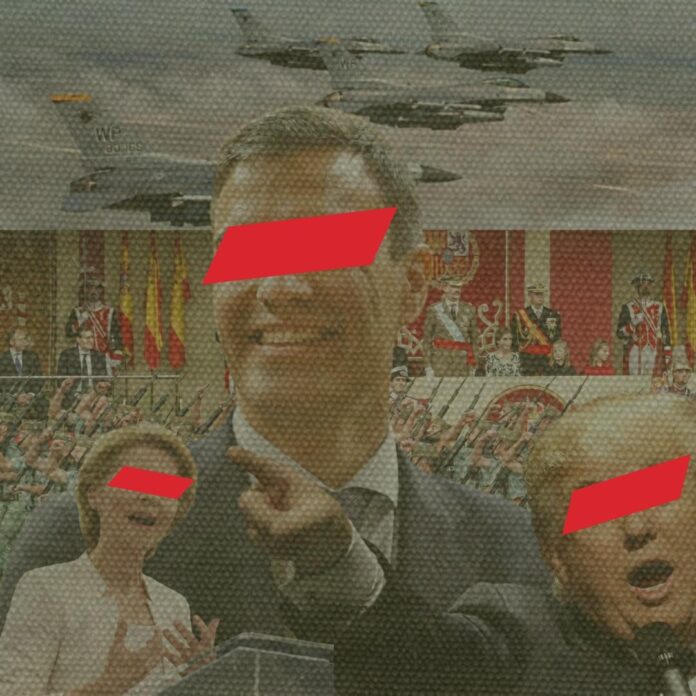
Analysis and Struggle Guidelines regarding the European Rearmament
The evolution of capitalism during the last few years have caused several phenomena that have made the internal contradictions of imperialist system more acute, with an outlook that show us:
- A general stagnation in production with even more recurring economic crisis.
- An increase in the number of wars and a worldwide increase in military investment due to the rise in imperialists unrest.
- The rise of the far-right in the imperialist countries, and the rise of open fascism in the subjugated countries, giving way to a fast loss of democratic-bourgeois rights and freedoms that many thought were set in stone.
In this context, in the instance of the European Union countries, the acceptance of the jingoist rearmament discourse is advancing rapidly, fully set in the whole bourgeois parliamentary arc in 2025.
US pressure, through NATO, to increase the military budged of all member States is not new. But for the EU, the new US stand with regards to Ukraine has caused a ruckus. Trump has given the European imperialist the cold shoulder in the negotiations with Putin. In order to end the Ukrainian War, paid off, by both Russia and Ukraine, in blood, the US and Russia have agreed to share the plunder of Ukrainian rare earth minerals between both imperialists countries.
The US has tried to calm the imperialist disputes with Russia, and to force the EU to realign with the new US doctrine, both in the military and political arenas. In this way, the US will focus their military capabilities on helping Israel and defending their interests in the Asia-Pacific region, in their fight against the Peoples’ Republic of China.
How real is the threat about war between the EU and Russia? Which interests are there by European Union member countries, the UK and the US? Which difficulties do they find to have a single cohesive imperialist policy? What is the relationship between the “European rearmament” with the rise of reactionary politics (both the rightwards turn in bourgeois politics and the investment in right wing policies and parties by the big capitalists)? And last, which position should the revolutionary proletariat adopt in this context? In order to answer this questions, in this article we will give an overview of our analysis about the EU and this rearmament, the Spanish political situation, and the revolutionary proletariat tasks in the face of the jingoist policies of imperialism.
1. The EU raison d’être.
Fist and foremost, we must understand that the EU is not an imperialist power per se: there has not been, nor there is, an unified financial oligarchy, nor the different imperialists States have melt into shared borders and policies. This pipe dream has only existed in the minds of a few reformist and liberal europeanists, too blind with the myth of the “European oasis” and the liberal triumph of the 1990s, and inside shoddy books penned by postmodern petit bourgeois academics.
The opposite is true, the EU is an imperialist project very little cohesive that we characterize as an alliance between imperialist powers with shared leadership, and in conflict, by France and Germany. Its existence is due to the overlapping interest of the oligarchy from the imperialists countries in the EU, but it is constantly being shaken by the contradictions among theses oligarchies. These contradictions dominate over the others. This was made manifest in the different answers to the 2008 financial crisis, later on with Brexit and the exit of the UK from the alliance, o recently with the German reserves in regards to the war in Ukraine.
In this respect, it is a project with a very shoddy design, mainly focus on trade rather than politics, aimed to get short term profit. Forced by WWII aftermath, the European Coal and Steel Community, and the European Economic Community (AKA “the European single market”) are set to give answer to the need of stability in order to rebuild the monopolies and adapt them to the new US hegemony that demoted the old European powers to a weaker position in regards to their status before the war. Even today, the EU is mainly useful to their member States to joint strategic “ventures” that on their own could not be carried out with the same proficiency.
In addition to this, the contradictions with the semi-colonies that are member States, most of them joined the EU in the early 2000s, after the fall of the Soviet social-imperialism and revisionism, with the exceptions of Ireland, Greece and Portugal, who joined before that. The Eu has been useful for the European oligarchies, mainly the German one, to bring together the semi-colonies and leash them: flood them with capital and wares, control their finances and its natural resources, and use their population as cheap labor.
In the imperialist camp, the EU powers are trying to develop a plan for a foreign policy independent from the US since the fist Donald Trump term, in 2016, a question that has come back in force due to his new electoral victory in 2024. To analyze this question must take into account the following: Armies are one of the ruling classes main tools to carry out their dominance. They have a double raison d’être: on the one hand, to protect the existence of the ruling classes, mainly against their own people, but also against other oligarchies o rival factions inside the bourgeoisie, and on the other hand to spread their imperialist dominion and increase their share of power.
Taking this into account, nowadays Russia is not an existential danger to the European oligarchies, but they can threaten their share of power, setting foot in Eastern European countries. However, a loss of control in that region in favor of Russia seems unlikely due to the economic, political and military quagmire that is the Ukrainian war for Russia, and to the relative firm dominion by the Western powers (the EU and the US) in Eastern Europe, even though the rise of pro-Russian political forces, like Viktor Orban in Hungary, or more recently, Calin Georgescu in Romania.
Anyhow, the European powers have had many difficulties to extent their imperialist dominion beyond Europe in the last decades, due to the fact that each oligarchy, as evidence of their lack of cohesion, has different power spheres (France in Africa, Germany in Eastern Europe, Spain in Latin America and the Sahel region) and are not willing to help each other pro bono. In other words, there is not enough cohesion in the imperialist projects of the different factions of the European oligarchy to move forward in an unified direction. In this situation, each financial oligarchy would like to prioritize their own turf rather than the others and to increase their share of power at the expense of their supposed allies.
2. The EU military weakness
The sum of all this factors makes a truly European army unlikely as long as this situation continues: nor the financial oligarchy is cohesive enough to use it efficiently due to the great monetary cost that his army would have, nor is their existence threatened in the short to medium term for them to be interested in it. Even half-way measures like enhance the interoperability of the armies form the EU countries are met with huge difficulties like the high dependency on the US for command, intel, and logistics in joint operations, the lack of power of the EU commissions in this area, the quarreling between the UK, France and Germany to increase their share of power in military matters, and a divided arms industry that fights each other in other to get a bigger share of the European budget.
European dependency on the US military infrastructure has been well illustrated by how decisive it has been for the Ukrainian resistance: commanders, members of NATO, are highly capable to plan and lead troops from different countries, and are able to turn this information into tactical strikes in enemy supply chains and command centers, anticipate enemy movements in order to carry out fallbacks and counterattacks and chose the proper weapons that each moment needs. Some examples of this is that ant the beginning of the war the US gave the Ukrainian infantry anti-tank weaponry to stop the Russian blitz, their intel (mainly satellite imaging) gave information about Russian movements which allow them to guide long range missiles to strike ammo depots and other key locations of the Russian army, they protected the Ukrainian command centers and logistical hubs with artillery. The US also gives high capacity air logistics for the quick deployment of troops, much higher that the EU can. This command knowledge and experience, being able to use the information provided by the military intelligence efficiently, intelligence infrastructure that makes possible to stablish electronic warfare resistant communication (where Musk’s Starlink has a prominent role), and being the US the main weapons and ammunition supplier worldwide, causes an EU dependency form the US that is very difficult to fix. [1] Even though that the EU and the US have had a similar monetary effort in order to support Ukraine (around 120 000 000 000 €) US support has been mainly military whereas the EU has been financial. Without the US the most probable outcome is that Ukraine was completely invaded by Russia.
On the other hand, the issue that inside the EU the semi-colonies are integrated by a formal political parity (without veto power by the more important countries, and without any established mechanisms of paralegal coercion in defense matters by the imperialist powers) hugely constrains the ability to have a unified leadership. As example: recently, the UK and France supported the idea of sending troops to Ukraine (trying to score some leadership points in this European rearmament) whereas Germany and Poland didn’t, even though they both support rearmament. The latter depend on Russian natural gas and are risking to pay the price of Russian retaliation to an insufficient troop deployment that is not a deterrent, knowing that there is not a capability to deploy troops outside their borders without US support. On the other hand, countries like Spain and Italy, whose power spheres are not in Eastern Europe, are against an European intervention in Ukraine, therefore they have some reservations against rearmament. It is to be expected that their performance is less strong and decisive, but they can not scape the US influence and their policies, which are supported the leading European powers (France, Germany, the UK).
This shows a weak point in the EU project: the existence of second class imperialist countries without any power to carry out their own political agenda (like Spain, Italy and the Baltic countries). This are breaking points in the theoretical European unity against the influence of powers beyond Europe, mainly the US and the PRC. The latter, for example, has made huge investments in the Barcelona and Piraeus (Greece) ports in order to get gateways into Europe for their wares and capital; Meanwhile the US keeps their strategic interest form one end of Europe to the other that, against the rise of Trump and his new policies, create strains throughout the EU even inside the imperialist powers, openly supporting far-right parties.
3. The Current Situation: Crisis, Rearmament and Reaction
This unequal outlook in the strength and influence of the different imperialist powers means that their alliances policies and their strategic deployment are constantly in contradictions against each other, and they have to adapt to the current political situation in order to not being left behind: that is why we point out that between imperialists the competition is absolute and cooperation is relative. Taking everything into account, already in our call for March the 8th we showed a relevant change in the international situation illustrating five factors, which we will expand here:
1. The economic stagnation in the US and the EU in the last two decades, due to the dynamics of monopoly capitalism, in which the “the tendency of the rate of profit to fall”. That is, simply put, that the investment needed to do business is getting bigger and the profit is getting smaller.
2. Increasing inter-imperialist tensions due to the shrinking of their super-profits. The profit that the imperialist countries can extract from the subjugated countries is getting smaller and the imperialist must fight against each other for their share of plunder: The US-PRC trade war or the Russian invasion of Ukraine are the most acute examples of the current inter-imperialist conflicts. The violent escalation of the settler-colonial state of Israel and their US masters in Palestine, Lebanon, Syria and Yemen due to the resistance of peoples struggles is also a relevant front of attrition for the US, as it represents a frontal opposition to imperialist plundering in the region.
In this context of stagnation and inter-imperialist conflict, the oligarchy needs a more vicious policy, both against their imperialist rivals as well as against the working class and the popular classes. This means:
3. Bourgeois States rearmament: Nowadays we see how the military and repressive investment by the NATO member states, including the Spanish State, have risen to record proportions, as well as in Russia and the PRC. Von der Leyen has announced a plan of several thousand million euros to rearm the whole of the EU due to the seemingly weakening of the alliance with the US, ignoring the infamous member states “debt ceiling” if it expands the military spending. This European investment plan will be carried out by a 800 000 000 000 € package for the next 4 years, a bit more than 1% of the European GDP, 650 000 000 000 € from the member states budget and the rest, 150 000 000 000 € from Union grants. Therefore, military spending will be shielded, isolated from the national debt limits imposed since the 2008 financial crisis. Even more, a lending mechanism will be established just for this rearmament, allocating European cohesion found to this issue, and rallying private capital through the European Investment Bank [2].
But EU countries do not only work in a collective fashion. Each member State is doing the same efforts: The UK announced the biggest increase in military spending since the Cold War [3]. In Germany, both conservatives and social-democrats have made a deal to exclude military spending from the “debt ceiling” and to massively invest in infrastructure and logistics [4-6]. In France, 2 years ago, Macron sketched a scheme for rising the military spending by 40% by 2030 and is flirting with reintroducing the draft [7]. On the other hand, Poland is the spearhead of this rearmament, having increased their military spending in more that 4% of their GDP in the last years, and having promised to rise it to 5% [8]. This shows the role that the semi-colonies will take in an hypothetical military conflict against Russia: cannon fodder for the imperialists. All these increases in military spending will weight heavily in the States budgets, and will mean austerity and cutbacks in social spending like healthcare and education: that is, cutbacks to the indirect wages of the working class. Which leads to the next point:
4. Popular classes living conditions are getting harder. Inflation, rising interest rates, housing profiteering overwhelm the working class, and trade union struggle is not currently able to rise wages at the same rate that the cost of living increases. Imperialism ability to bribe and accommodate some working class echelons is drastically shrinking, causing a general proletarianization process that we can see in many places, not only in the living conditions but also in the loss of work autonomy, overcrowding and proletarianization of jobs that used to be exclusively petit bourgeois, etc. This hardening of the living conditions causes popular outbursts and riots, that overlap with the different democratic (women’s rights, LGBT rights) and political (like the Palestinian solidarity ones) protests. This makes difficult the continuity of a stable government and without hiccups that the oligarchy was so used to during the neoliberal rise in the 1990s and early 2000s.
5. Therefore, financial oligarchy needs a more aggressive internal policy in order to defend their interests: their new gamble, the far-right. This political force is not new, and has had an increased importance since the 2008 financial crisis, showing that they were a gamble favored by a bigger share of the medium and big bourgeoisie from the imperialists countries. However, the far-right has not turned into the Western financial oligarchy main political gamble until very recently.
The far right is needed to validate the need of defending the country from an external threat, justify military spending and involvement in wars, also to give a populist answer to the economic hardships criminalizing popular class segments like immigrants and gender dissidents. This frontal attack against minorities tries to make the contradictions among the people more acute and easing the passing of legislation to lower the labor costs, making profitable to bring back to the metropolis the industries that are now outsourced to the more unreliable semi-colonies or that add logistical costs along the production chain. The ultra-liberal and climate change denialism legislation sponsored by the far-right try to lower the environmental protections to ease natural resource extraction and polluting products manufacturing inside the country, bringing back these previously outsourced issues.
This trend is also happening in the subjugated countries, with Millei in Argentina, Bukele in El Salvador, Noboa in Ecuador and the ultra-conservative regimes of Eastern Europe. This rise is due to the stagnation and the rising internal and external tensions. The reelection of Trump in the heart of worldwide imperialism and the implementation of openly reactionary legislation is a turning point in this development.
4. The Spanish political situation
In Spain, as with the rest of Europe, in the latest years, far-right political positions have gained relevance. With a similar discourse as “MAGA”, our country’s oligarchy has taken out their liberal-moderate mask from the last decade and now labels immigrants as the cause of the economic hardships, ignoring on purpose the relationship between the poverty that the immigrants are forced to live in and crime. Along side, mass media floats the idea of the proximity of a war, either against Russia either against PRC, trying to create a rationale about increasing military spending in the public opinion. Even though there is a social-democrat government, the Spanish State does not, nor can not, run away from the need to rearm and remilitarize, because social-democracy [9], even selling themselves as the “lesser evil” in service of the capitalists, is just another bourgeois front representative. In fact, during the 2020-2023 period military spending increased in 7 000 000 000 €, with Podemos in government, even though now they are making a fuss in regards to the rearmament question. The petit bourgeois reformist parties like Sumar, Podemos, ERC, Bildu, BNG or Compromis, more or less overtly, end up supporting militarization in order to keep their jobs [10, 11], and opportunistically criticize it whenever it suits them [12].
Full analysis shows that “European rearmament” is not answering to an imminent threat of war, but a response of the European imperialist to the US change in policy regarding continuing their military support to Ukraine. The US has chosen to share the plunder in Ukraine with Russia, normalizing their diplomatic relations in order to pacify one of their open fronts to focus on Taiwan and Palestine. This, in turn, makes the EU to adopt the position that the US demanded, reinforce their military capacity, and turn their governments rightwards to justify it.
However, the strengthening of the EU imperialist alliance have different meaning for Germany, France or the UK; Germany prefers a fast rearmament but without direct involvement in the Ukrainian War, France and the UK prefer to deploy troops in Ukraine as soon as possible. Moreover, they start from a inherent weak position: The EU was created as a tool of economic subjugation, and has not any mechanism to easily force weaker member states to adopt a joint defense policy, nor the European imperialist powers have a shared sphere of influence that aligns with their interests.
The Spanish oligarchy is not particularly interested in a quick rearmament, because of this the PSOE and SUMAR government is masking out an increase in military spending by doing some accounting tricks so some budget items that were not counted as military spending are now counted as such. In this way they can reach the 2% of GDP required without spending a single Euro.
These and other splits and differences between the EU member states will be noticeable, but this should not mislead us. The “European rearmament” is primarily to close ranks inside the EU, to secure their external dominion (Africa in the case of the French, Eastern Europe in the case of the Germans), and to get ready for an increase of inter-imperialists conflicts in the middle term. And this will also be carried out in Spain.
In this new context, the so-called progressive regime, absorber and assimilator of resistance movements so they become complicit in the management of capitalist wretchedness has exhausted its usefulness. It is necessary to legitimize the sacrifices to be made for the good of the imperialist nation. And is also necessary to limit, even to crush any kind of dissent that can turn against them. Because of this the far-right has become the political gamble of the US and EU oligarchies.
Inside the imperialist countries: the small far-right parties gain influence, financing and voting intention.; the traditional conservative parties are radicalizing, the social-democrat parties have happily taken the role as “statesmanlike parties” justifying to the broad working masses the need for rearmament; and the reformist parties accept this because “even this is not the world they would like to live in, homeland defense must be strengthen” as they have a minimal share of bourgeois power. The parliamentary arch rightwards turn that we have seen in recent years has quicken. It is noticeable that the reformist possibilism has weakened their political positions, their positions in power have increased their cretinism, and, in the last decade, we have noticed social-chauvinist discourse in those formations that supports the government (ERC, SUMAR).
The far-right is key for the financial oligarchy: it allows at the same time (1) to predispose the masses to accept the “necessary sacrifices” while (2) it legitimizes the open repression (legal and para-legal) of the “dissidents and undesirables”. With the support of the social media algorithms and the mass media, they have launched an offensive of criminalization against the immigrants, as well as, in parallel, against gender dissidence, aided and abetted by the social-democracy. These are the keystones to lash out against any kind of dissidence: the LGTB community, feminists, ecologists, communists and even progressives. Anything “woke”. This links up with their recruitment campaign: to be rebel is to go against all that, which is part of the “Establishment”; thus creating a dangerous mass base.
This is to say, “European rearmament” is a campaign to fatten the far-right: a political force financed by the oligarchy that nowadays carries out a cultural exercise to create a mass consensus so the masses accept the loss of rights and democratic freedoms, the worsening of exploitation, austerity, as well as to create a reactionary mass base that can be mobilized to pressure dissidents, that is concatenated to a business network and in institutions.
Inside this business network the most relevant companies have been technological companies that control the main social media sites like Meta (WhatsApp, Instagram and Facebook), Google (Youtube) and Tesla (X, FKA Twitter), and the mass media as complementary support have worked in order to crate this mass base. Social media has served as propaganda machines with a massive capability of broadcasting the new reactionary agenda, far superior to the capabilities of bourgeois mass media, and with a more than proven effect in the bourgeois electoral circus, mainly among young men.
This activity drags rightwards the whole political spectrum, while a far-right government means the overt application of these anti-popular policies, their absence in government means that the same policies will be applied gradually, forcing the masses to agree with the outlook of “this is the furthest we can go” or “vote me in order to stop the fascists”.
This drags the whole parliamentary arch. Closing ranks to be in a better position to secure their dominion both home and abroad.
5. The political position of the revolutionary proletariat and the tasks that communists must carry out.
“European rearmament” is an obedient answer by the European financial oligarchy to the demands for NATO militarization headed by the US, as well as the first imposed political measure by the new US administration, which is the flagship of this new policy that drives from now on the global superpower towards their allies. There is not an imminent threat of war escalation, nor fascism inside imperialist countries, but there is a context of progressive increase of inter-imperialists tensions and the beginning of an offensive against democratic rights and freedoms, of austerity, and the worsening of exploitation.
Thar is why, although the opposition to imperialist war (and to turn it into a revolutionary civil war) and to develop the capacity to stop and fight fascism are issues that the communist movement must deepen their knowledge and practice, are not the main task to carry out. Rather, adopting this outlook is to roll out the red carpet for the puffed up discourse by the social-democracy and the reformists, to support their administration which is wretchedly servile to the capital, the social-democracy and the reformists have been carrying out the oligarchy policies while shedding crocodile tears, and to allow them to once again cry wolf, “vote me to halt fascism”. In this new context, reformism goes from being the main enemy to being a relevant secondary enemy, which we should not forget in order to limit their influence when we fight the main enemy, represented by the far-right.
We come from a position of weakness: trade-unionism is dominated by the labor aristocracy, trade union bureaucracy is subservient to the governing social-democracy, the urban grassroots movements only gather together a very small fraction of those that could struggle for those collectives, and those critical of reformism are subdued by petit bourgeois outlooks which isolate them from the masses (irrealist radicalism, performative pacifism). Because of this we must pay attention to the framing with which we can go from the current situation to an open struggle against the reaction, a process which also helps a working class and peoples ideological, political and organizational strengthening while we weaken the bourgeois State.
We pinpoint three resistance struggle axis. All of them should begin from the actual forms of struggle, isolated and domestic, increase their mass and forcefulness, and to leap forwards in order to become part of the general political struggle:
1.- Trade union struggle against the worsening of exploitation in the workplace: we must begin from the organization which is the most important in the struggle company by company, committee by committee. Trade union section which are fighting must be the base to pressure the trade union bureaucracy inside the big trade unions. The aim of this pressure must be that trade unions become tools to the service of the working class and the peoples political struggle, especially in the mid-term, within the context and struggle sharpening, so that they bring the powerful tool of general strike back.
2.- Urban grassroots movements struggles in defense of public services and other demands, like housing access (limitation of indirect exploitation, and the defense of the indirect wage), starting from the actual existing organizations, among which the neighborhood organizations stand out, and picking up the baton from the grassroots movements of the previous decade, in order to gather together in struggle more and more fractions of the people, uniting particular demands (stopping measures at the local level) with general demands (halting regressive legislation, austerity, or the absence of regulation like for example in the housing market) and the political struggle against the interest of the financial oligarchy.
3.- Peoples struggles for democratic freedoms and rights. We pinpoint that nowadays the tip of the spear of the reactionary discourse is the criminalization on immigrants and racialized peoples, as well as the persecution against trans people. This is part of a general offensive against nay progressive idea. The working class and the people must fight against the reactionary persecution of racialized and trans people which is an offensive against the whole of the people. Peoples auto-defense will be spontaneously organized by specific organizations. But also we must push forward the idea in the workers and peoples organizations that the racialized and trans peoples demands are part of a general struggle against a type of more overt and bloody capital dictatorship.
The struggle for demands arises spontaneously, but the consensus that arises naturally from it is the reformist outlook: changing this or that wrongful aspect of the current system, which seems doable within a reasonable time framework. There is where the parliamentary initiatives, the political theater by several opportunists, the influence of social-democrat realism and the disappointing reformist possibilism take us to a well known dead-end.
Because of this, the task for the communist is to concern us with articulating the different conscience levels that arise within the struggle. As for the most advanced from the class and the people, we must avoid that their rejection of reformism take them to isolate themselves from the masses which are significantly influenced by the bourgeoisie “left” outlook. Setting up advocacy organizations whose main activity is the overt critic of capitalism makes these organizations marginal, surrendering the masses to bourgeois influence. On the contrary, the most advanced mas be mass organizers and propagandist of revolutionary ideas to the most advanced factions of the masses. The political struggle organizations, within themselves, must be schools of socialism and schools of struggle.
Workers and peoples organizations can breach peoples consciousness through effective agitation against the anti-popular legislation by the bourgeois right and the hypocritical claims by the reformist and social-democrat left. Political education must be a cornerstone of the organization internal dynamics in order to ideologically lift and train the new members from these collectives.
In the absence of this effective agitation that dots the i’s and crosses the t’s, that brings a working class outlook forwards in the face of the masses troubles (and not a generic anti-capitalist discourse), the anti-popular legislation and the abandonment of the working class by the bourgeois bloc are being channeled by the far-right discourse.
The aim of political agitation and education within workers organization must be the breaking point with the opportunist bourgeois ideology, that puts on and takes off the progressive costume as it suits, and deploying class politics, that brings the interest of the working class to the fore, which serves the people in their struggle, and which sets the foundations to be able to convey a revolutionary outlook as the situation worsens and the working class and peoples level of consciousness have developed enough. This is the right way in which we can move from a defeatist logic of defending the lesser evil to dead, to an attack logic which is ready to not take an step back.
The advancement of the capability for working class and peoples organization and struggle will be tightly linked to the development of the revolutionary movement. This, by definition, is the most consistent and most indomitable part of the workers and peoples struggle. And by necessity, their most dedicated, capable, and aware will become the proletariat general staff in their fight against the bourgeoisie in order to end all kinds of exploitation and oppression. This general staff is the Communist Party. An organization which is built by merging the most committed and the most aware people within the the workers movement and social struggles.
The tense situation that we live in is not different from the early XXth Century, when the conflicts among imperialist began to bubble up, gunboat diplomacy was imposed onto the subjugated countries, and the different oligarchies yearned for their rivals colonial possessions. This situation leaded, fifteen years later, to the Fist World War. Unfortunately, nowadays we live in a situation where the international communist movement is significantly weaker and where there is less working class organization than at that time. We can not fall into the “lesser evil” and “halting fascism by the ballot box” cycle, but we have to strengthen the mass organizations, rebuild the Communist Party and, as the Bolsheviks did in 1917, be able to turn the imperialist war into a revolution whenever this war shows up.
Sources
[1] https://www.descifrandolaguerra.es/europa-no-puede-sustituir-ayuda-estadounidense-ucrania
[2] https://www.descifrandolaguerra.es/von-der-leyen-rearme-europeo-800-mil-millones/
[5] https://www.bbc.com/news/world-europe-64346218
[6] https://www.kyivpost.com/post/48997
[9] https://www.publico.es/politica/gasta-espana-defensa-aumentado-presupuesto-anos.html
[10] https://x.com/ElHuffPost/status/1900149173342609631